
Walking across your living room shouldn’t feel like navigating a trampoline. When floors begin to dip, slope, or bounce beneath your feet, it is rarely a cosmetic issue with your hardwood or carpet. Instead, your home is sending an urgent warning sign that something is structurally failing in the crawl space directly below you.
For homeowners across Central Indiana, structural shifting is a stressful discovery. However, understanding the symptoms, identifying the root environmental causes, and deploying modern engineering solutions can safely halt the decline and restore your home’s structural integrity.
The Warning Signs: How Your Home Signals a Crawl Space Failure
Because structural damage happens gradually beneath the subfloor, many homeowners overlook the early indicators. If your foundation is compromised, you will typically notice a combination of these three classic household symptoms:
- Bouncy or Spongy Subfloors: When you walk across a room, do the floorboards yield or vibrate? If your floor system loses its rigid counter-force, it means the underlying support network is deflection-strained or compressing.
- Sloping or Gapping Baseboards: If you place a level on your floor and see a dramatic tilt toward the center of the structure, or if noticeable gaps open between your flooring and your baseboard trim, your internal support columns are actively sinking.
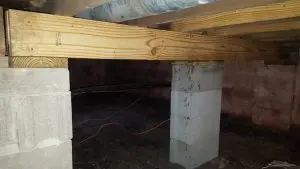
- Sticking Doors and Drywall Cracks: Your home’s frame acts as a unified skeleton. When a crawl space beam drops even a fraction of an inch, it pulls on the upper wall frames. This causes interior doors to bind or stick in their frames and forces diagonal cracks to spiderweb through drywall, particularly above window headers and door openings.
The Root Causes of Structural Sagging in Indiana Foundations
Indiana homes are uniquely vulnerable to foundation settling due to our regional climate and geological conditions. Structural sagging is almost always driven by two compounding forces: soil instability and unmanaged moisture.
1. Saturated Clay Soils and Footing Settlement
Central Indiana is covered in highly expansive clay soil. This type of earth acts like a giant sponge—it swells drastically when saturated during heavy spring downpours and shrinks aggressively during dry late-summer spells. This continuous movement exerts immense hydrostatic pressure (water pressure pushing against the foundation from saturated soil). Over time, this shifting soil causes the original concrete block piers or shallow footings supporting your home’s main central beam to sink unevenly into the ground.
2. Wood Rot and Structural Weakening
The second major threat is moisture accumulation. Raw earth crawl spaces continuously evaporate gallons of water vapor into the air every single day. Due to a natural phenomenon known as the stack effect (the natural movement of air upward through a building as warm air rises and escapes through the roof), this damp air is drawn upward against your floor joists. If your crawl space lacks a high-quality vapor barrier, this constant humidity creates a perfect breeding ground for wood-boring mold and fungi. As the wood rots, it loses its load-bearing capacity and begins to crush and compress under the physical weight of your home.
Professional Engineering Solutions: How We Restore Structural Integrity
Fixing a sagging floor requires permanent, heavy-duty engineering solutions that address the root cause of the settlement. Shimming or temporary patchwork will not suffice. Professional stabilization typically relies on two primary methodologies:
Heavy-Duty Steel Support Jacks
The most reliable way to lift and stabilize sagging floors is by installing adjustable, high-strength steel support columns. These systems are engineered to replace or supplement failing concrete block piers. Our field technicians excavate a deep, solid concrete footing beneath the crawl space floor to create an unyielding foundation. A heavy-duty steel jack post is then mounted to the footing and secured to the main overhead support beam. Using precision mechanical tools, the jack is gradually adjusted to lift the floor back toward its original level, permanently stabilizing the weight load above.
Floor Joist Sistering and Beam Replacement
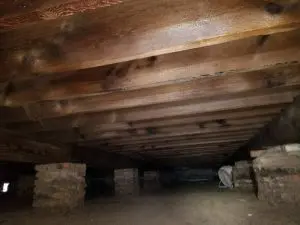
If moisture has caused localized wood rot, the compromised lumber must be structurally reinforced. This is achieved through floor joist sistering (attaching a new, strong wooden beam directly alongside a compromised or rotting one). The new joist is securely bolted to the existing frame, effectively doubling its structural strength. In cases where the central main beam is entirely compressed, our crews safely shore up the home’s weight, extract the rotted wood, and install a brand-new multi-ply or engineered lumber beam.
A Warning on DIY Shimming: Attempting to drive wooden wedges or use automotive jacks to level your own floors is incredibly dangerous. Over-correcting a sagging floor too quickly can fracture hidden plumbing lines, crack load-bearing structural members, and cause severe, permanent cosmetic damage to upper levels. Structural leveling requires precise load calculations and specialized equipment.
Frequently Asked Questions
Q: Can you fix a sagging floor without replacing all the wood in the crawl space?
A: Yes, absolutely. In the majority of residential cases, the existing wooden floor joists are still structurally viable but simply lack adequate physical support because the central piers have settled. By strategically introducing adjustable steel support jacks, we can stabilize and level the floor system efficiently without the massive, invasive expense of a total subfloor tear-out.
Q: How long does a crawl space structural beam repair take?
A: Most standard residential stabilization and beam repair projects throughout Indiana can be completed within 1 to 3 days. The exact timeframe depends on the total linear footage of the damaged beams, how many support jacks are required, and the physical clearance and accessibility of your crawl space foundation.
Q: Will homeowners’ insurance cover sagging crawl space repairs?
A: Generally speaking, standard homeowners’ insurance policies do not cover structural stabilization or wood rot repair caused by long-term moisture exposure, ambient humidity, or natural soil settling. Insurance is designed to cover sudden, accidental incidents. However, if your structural failure was the direct result of a sudden covered peril—such as a catastrophic burst internal pipe water rupture—partial coverage for the remediation may apply. Always verify your specific policy terms with your insurance adjuster.
Take the Next Step Toward a Stable Home
Left unaddressed, structural sagging will only worsen, causing compounding, expensive damage to your home’s framing, cabinetry, doors, and finishes. Don’t let foundation settling threaten your property’s safety or market value. Contact Indiana Crawl Space Repair today to schedule a comprehensive structural evaluation and custom stabilization estimate with our specialized Central Indiana field engineering team.

Since we are constantly working on damp crawlspaces and wet basements in the greater Indianapolis area, we are experts in structural floor repairs too. Whether you have sagging, bouncy, or unlevel floors, our solutions can help you.
Plus, we’re not only waterproofers, but we’re experts in structural floor repair. Whether you have foundation cracks, drywall cracks, or sagging floors, our structural repair specialists can help fix the problem. We’ve fixed hundreds of foundations and floor systems in homes and commercial buildings throughout the area.
Fixing your damp basements and crawlspaces before it becomes a big problem is the most affordable and effective option. You’ll avoid extra costly structural repairs and decreased home value. For our trained crawlspace technicians, a typical crawlspace repair usually takes less than a few days to complete. Many of our systems come with a warranty – so that you know the problem was fixed right. Give us a call us at 317-893-7016 to request a professional evaluation from our foundation repair experts.
**Lifetime Transferrable Warranties are for the lifetime of the home or 2 transfers of ownership. The CrawlDrain drainage system warranty guarantees no standing water in the crawl space. The sump pump is a 3 year parts and labor warranty. The CrawlSeal encapsulation system warranty guarantees the seams, sealants, and against rips or tears in the plastic. For more information about the warranties, request a copy of the warranty.